This post has been a long time in the making – so has the dead hedge! but that’s the thing about gardening and maybe the environment in general – stuff takes time to do.
April 1st:
The day started out with my family assuming I was trying to wind them up with an April Fool’s Day joke. Along the lines of they can see my lips moving and hear the words coming out of my mouth but none of it makes any sense. Got to be a wind up, right?!
If I’m honest the 1st of April normally passes me by but it was the weekend so perhaps I had a bit more time to think about it. I would probably have got more feedback if I’d proposed painting the house purple, but like so many things where I hope something will capture the collective family imagination! this definitely fell flat! They were genuinely confused about the concept so they just shrugged, the universe carried on spinning and I disappeared out to the garden. My mission – Project Dead Hedge. Yeh, I know – that doesn’t sound very exciting or April Fools ish either for that matter.
Mr Treading Softer noticed me gone at some point and came out to find me dragging bits of shrubs and trees down the garden. I was quite relieved for his help since I’m not supposed to be ‘over doing’ it. I tried again to explain I was building a dead hedge. He really didn’t believe me………. April Fool’s Joke? But the for the fact I was really moving stuff down the garden and had the big loppers out I think he might have slunk back to the house!
What’s a dead hedge? I hear you ask……..
It’s in the same context a bug hotels and log piles. A dead hedge is just that, a hedge like structure created from dead woody plant material from the garden. I call them prunings but really it can be any length of wood, branches from trees and shrubs created when you cut back a shrub or reshape a tree. The prunings are piled up between two lines of parallel posts to create a structure that insects and spiders can live in and hopefully other creatures like hedgehogs can use it for shelter and little corridors to travel along.
We generate a lot of prunings in our garden and rather than continually fill up the green bin I thought we could start using more of them in the garden. Hence the dead hedge came into being. We used Hazel for the posts and then laid prunings from Hazel, Cotinus, Cornus and Budleija amongst other shrubs and some prunings from an apple tree. As the woody material at the bottom breaks down you can just add fresh prunings on top. People create dead hedges of epic length and size but our hedge is a little over 1 metre tall, although for most of the summer it was about half that height as we slowly added prunings to the top. It is 3 metres long and the Hazel posts are about half a metre apart creating a half metre wide hedge.


Sorry for the slightly wonky pictures – When we started in April the dead hedge wasn’t much to look at!
September
We have added other branches to the dead hedge though the year as we have been cutting back and reshaping some of the shrubs in the garden.
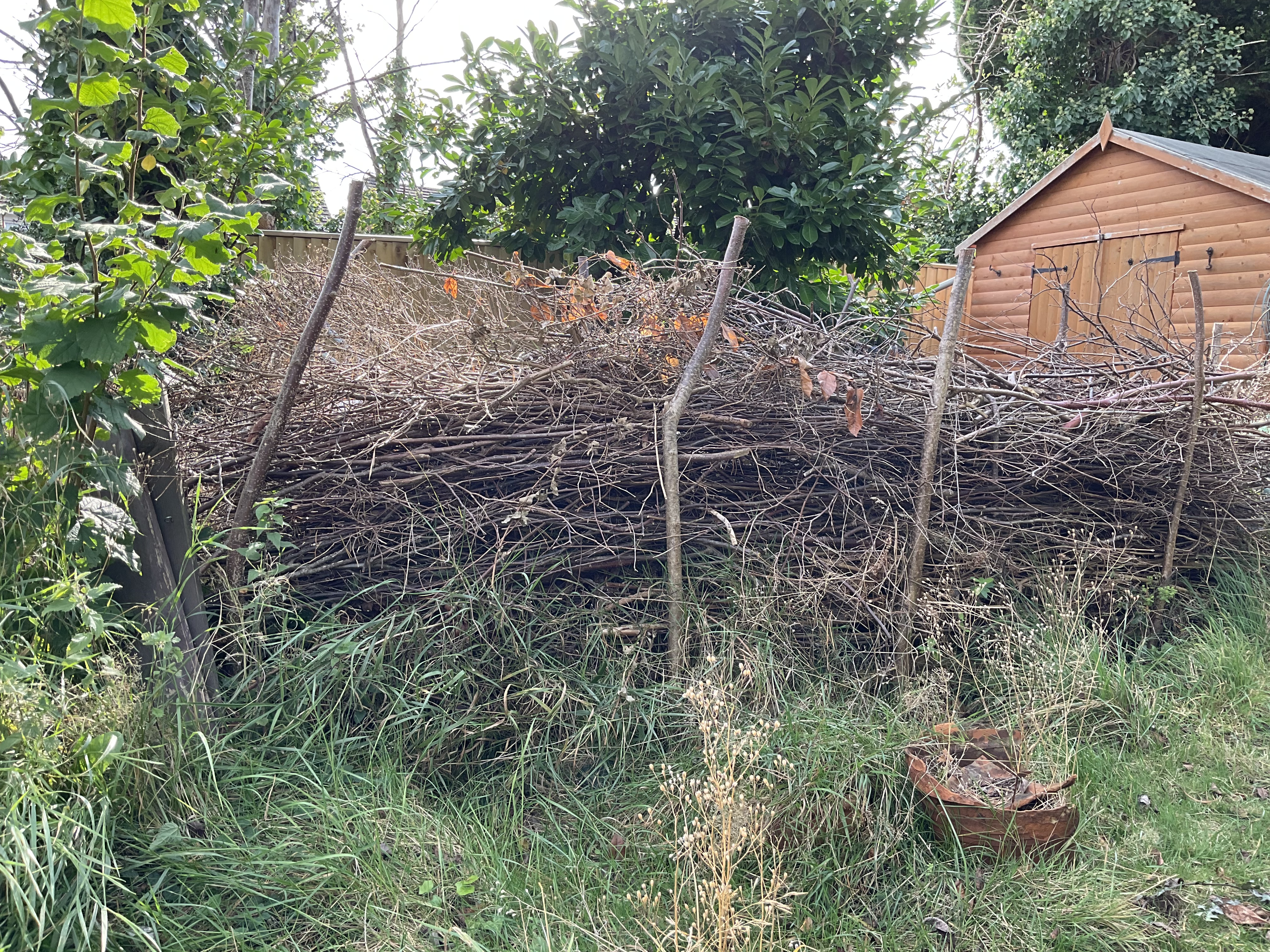


I planted a small honeysuckle plant and some night scented stocks seed to put at the base of the hedge to add a little more variety. Although the seeds were sown into bare ground the grass very soon swamped them so I don’t think they got as far as flowering. The little honeysuckle plant is valiantly still there with a few leaves left.
The bottom image is the valiant tiny honeysuckle trying to establish itself in the shadow of the dead hedge after being dug up by the local badger and after the drought and heat of July. Now its October and I can report it is still there. We’re all rooting for you……….. little honeysuckle.
Anyone else created a dead hedge or bug hotels in their garden? I’d love to know.
Have a good week everyone.
 WeAreTreadingSofter